
Hair Thinning After 40: Cuts and Styles That Add Density
It’s usually the ponytail that tells you first.
You’ve been wrapping the hair tie around three times for years, and then one morning it goes round three times and there’s still slack. Or you catch your parting in a changing room mirror under that particular unforgiving overhead light, and it looks wider than you remember. Or someone takes a photo of you from behind at a family thing and you spot the crown and think, hang on.
Nobody warns you about this bit. There’s plenty of conversation about grey hair, and a fair amount about wrinkles, but the slow loss of density that happens for a lot of women through their forties gets talked about far less. Which means when it starts, it can feel isolating in a way it really shouldn’t, because it is genuinely common.
The good news is that the right cut makes a visible difference. Not a miracle, and I’m not going to pretend otherwise, but a real, noticeable, look-in-the-mirror-and-feel-better difference. Some of the styling adjustments are almost embarrassingly simple.
Before any of that though, there’s one thing worth sorting out first.

Rule This Out Before You Book the Appointment
I’m putting this near the top rather than tucking it at the bottom, because it matters more than anything else in this article.
Thinning hair after 40 is often just the ordinary shift that comes with changing hormone levels, and a haircut is a perfectly reasonable response to it. But sometimes it’s a sign of something else, and no haircut in the world addresses that.
Worth a conversation with your doctor if any of this sounds familiar:
- The thinning came on quickly rather than gradually over years
- You’re losing hair in patches rather than evenly across the top
- Your scalp is sore, itchy, flaky or visibly irritated
- You’re also dealing with fatigue, unexplained weight changes, feeling cold constantly, or brittle nails
- Your periods have become irregular or unusually heavy
- It started within a few months of a significant illness, surgery, major stress or a new medication
Thyroid problems and low iron are both extremely common in women in this age bracket, both cause hair loss, and both are picked up with a straightforward blood test. Female pattern hair loss is also common and there are treatments a doctor or dermatologist can talk through with you.
I’m a hair person, not a medical one, and I’d rather say this plainly than have someone spend money on a fancy cut when what she actually needed was a ferritin test. Get the check, then come back to the fun part.

What’s Actually Going On Up There
Assuming you’ve ruled out anything that needs treating, here’s the simple version of what changes.
Individual hairs get finer. Each strand comes in with a smaller diameter than it used to, so even if you still have roughly the same number of hairs, the total volume drops. Your ponytail gets thinner without you actually losing that many hairs.
The growing phase shortens. Hair that used to reach your mid back now seems to stall somewhere around your shoulder blades and refuse to go further. It’s not breakage necessarily. It’s that the hair is shedding before it gets a chance to reach that length.
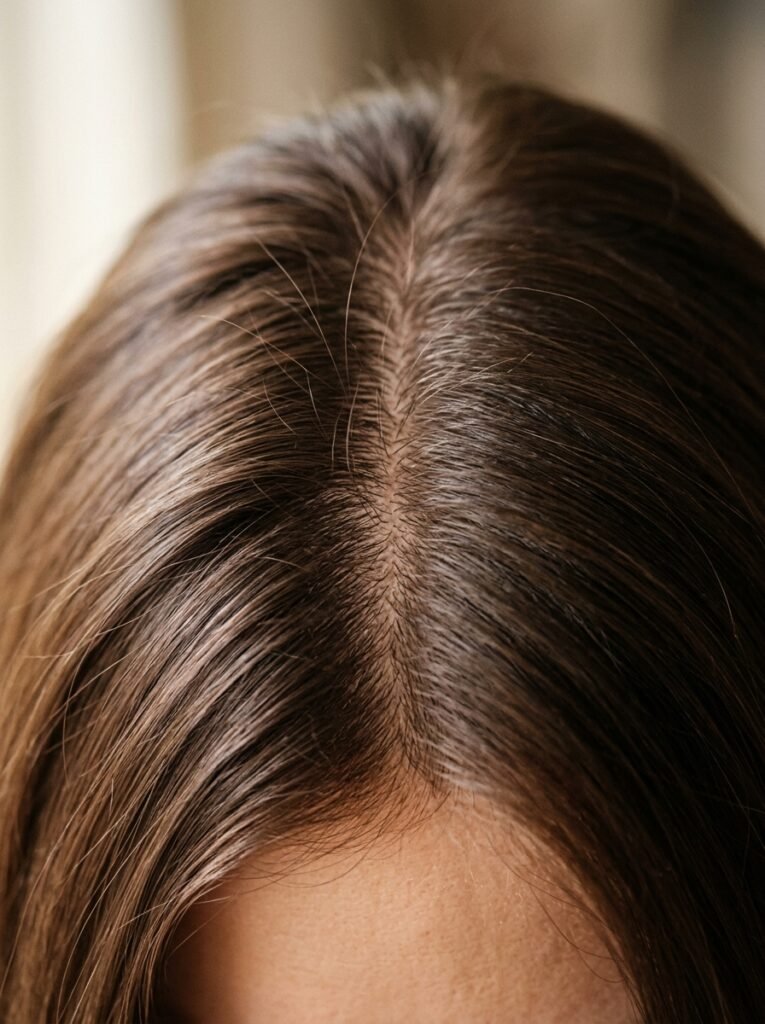
Density thins most at the top. The parting, the crown and the temples usually go first, while the hair around the back and underneath often stays reasonably full. This is why so many women feel like their hair looks fine from behind and disappointing from the front.
And the scalp becomes more visible, which is really the thing that bothers most people. Not the hair itself, but the skin showing through.
Understanding that last point is what makes the cut advice make sense, because almost everything below is aimed at one thing: reducing how much scalp shows and making the ends look substantial.
The Length Decision Nobody Wants to Hear
Let’s deal with the hard bit first.
Long hair is usually working against you here. I know. I resisted this for about two years and I’m still slightly annoyed about it.
Two reasons. The first is weight. Long hair pulls flat at the root, and root lift is the single most effective thing you have for hiding a wide parting. The second is that thinning hair tends to taper toward the ends, so length exaggerates the problem. You get a thin, wispy point at the bottom that draws the eye straight to how little hair is there.
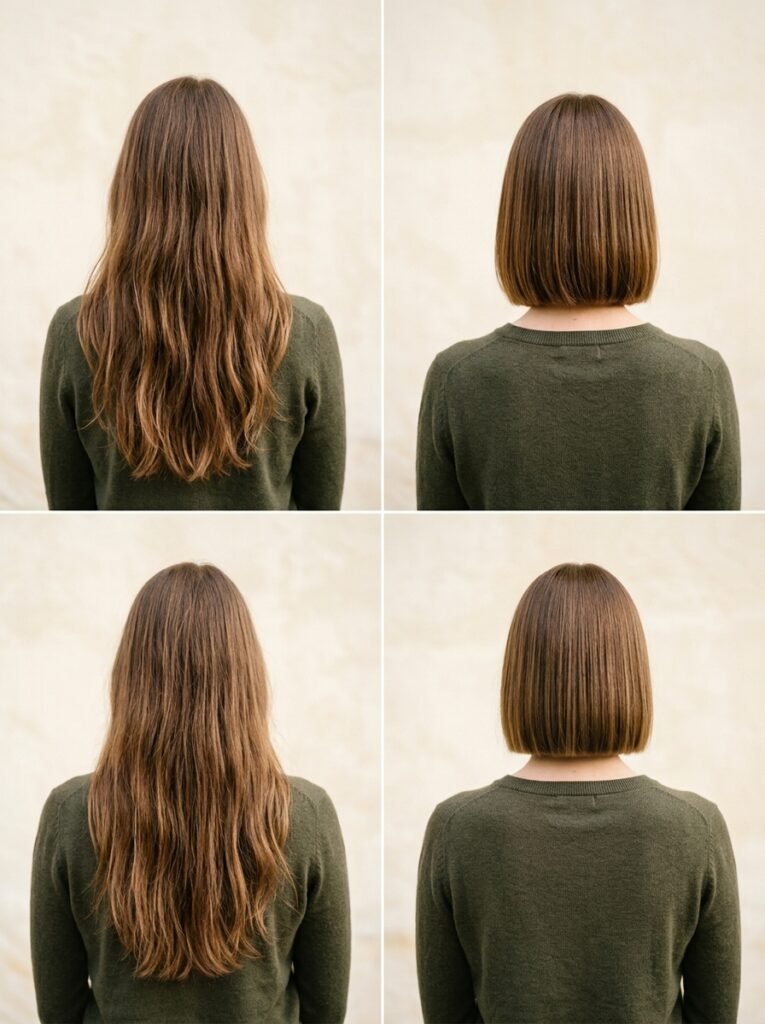
This does not mean you have to cut it all off. That’s the fear, and it’s overblown. Most women get the effect they want somewhere between the collarbone and the jaw, which is nowhere near a crop.
A cut that ends around the collarbone or just above tends to be the sweet spot. Enough length to still feel like long hair, short enough that the ends stay blunt and full and the roots get some natural lift back.
If you love your length and you’re not ready, the compromise is a strong blunt line at the bottom. Cut the wispy taper off even if you keep the length. That alone changes how the whole thing reads.
Cuts That Do the Heavy Lifting
Rather than listing every haircut ever invented, here’s what each option is actually doing for you.
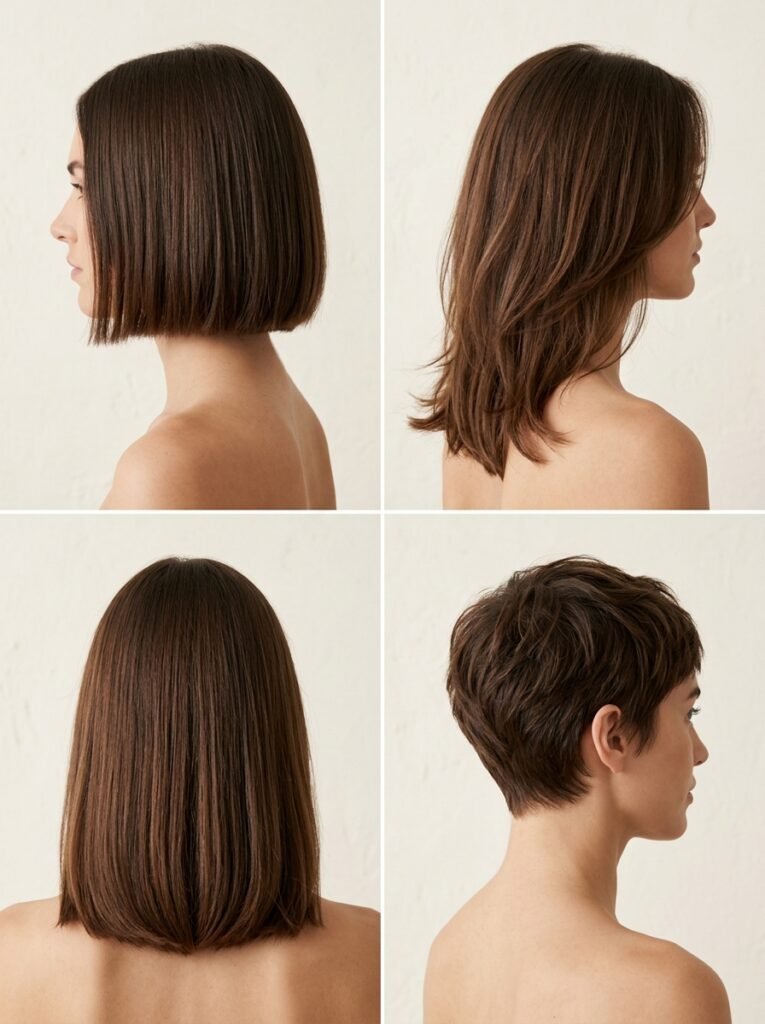
A blunt bob. The most reliable choice, and there’s a reason it’s recommended constantly. A single strong line at the bottom stacks all your remaining hair into one dense edge. Jaw length or slightly below works for most people. Keep the internal layering minimal, because layers remove weight and weight is what you’re trying to keep.
A collarbone cut with soft, long layers. For anyone not ready to go properly short. The layers need to start low, well below the chin, and stay subtle. Short choppy layers through the top will scatter what density you have and make the crown look worse.
A blunt lob with a slight bevel. Same principle as the bob but longer, with the ends turning under very slightly to build the illusion of thickness at the bottom.
A textured pixie. The most effective option for significant thinning, honestly. Very short hair sits away from the scalp instead of lying flat against it, which means less scalp visible, not more. It’s counterintuitive and it puts a lot of people off, but the women I know who’ve gone this route almost universally say they wish they’d done it sooner.
A shorter cut with soft face-framing pieces. Adds movement around the face without removing bulk from where you need it.
What tends not to work: heavy internal layering, long thin layers through the crown, aggressive thinning shears, razored ends, and any cut described as “wispy” or “feathered.” Every one of those removes weight from hair that hasn’t got weight to spare.
Two Women, Two Very Different Solutions
A friend of mine noticed her parting widening at 44. She had waist length hair and absolutely refused to cut it, which I completely understood. What she did instead was take about four inches off, blunt across the bottom, and switched her parting from the dead centre to a deep side. That was it. Two changes, one appointment, and the difference in photos is genuinely startling. She still has long hair. It just reads as much thicker.
My neighbour went the other direction. Hers had thinned properly across the top after a rough year, and she’d been doing that thing where you grow it long and tie it back to hide it, which almost always makes things look worse rather than better. She cut it into a short textured crop, quite short, and cried in the car afterward. Two weeks later she told me she hadn’t felt that good about her hair in a decade. The scalp that had been showing through flat, tied-back hair simply stopped being visible once everything stood up and away from her head.
Neither approach is the right one. They’re just different problems.

Styling Changes That Beat the Haircut
Genuinely, some of these do more than the cut does, and they take minutes.
Move your parting. The most underrated trick there is. Hair that’s been parted in the same place for years has learned to fall flat there, and the parting itself has widened through habit as much as anything. Shift it two centimetres over. It’ll look odd for a day or two and then it’ll settle, with noticeably more lift at the root and a less obvious gap.
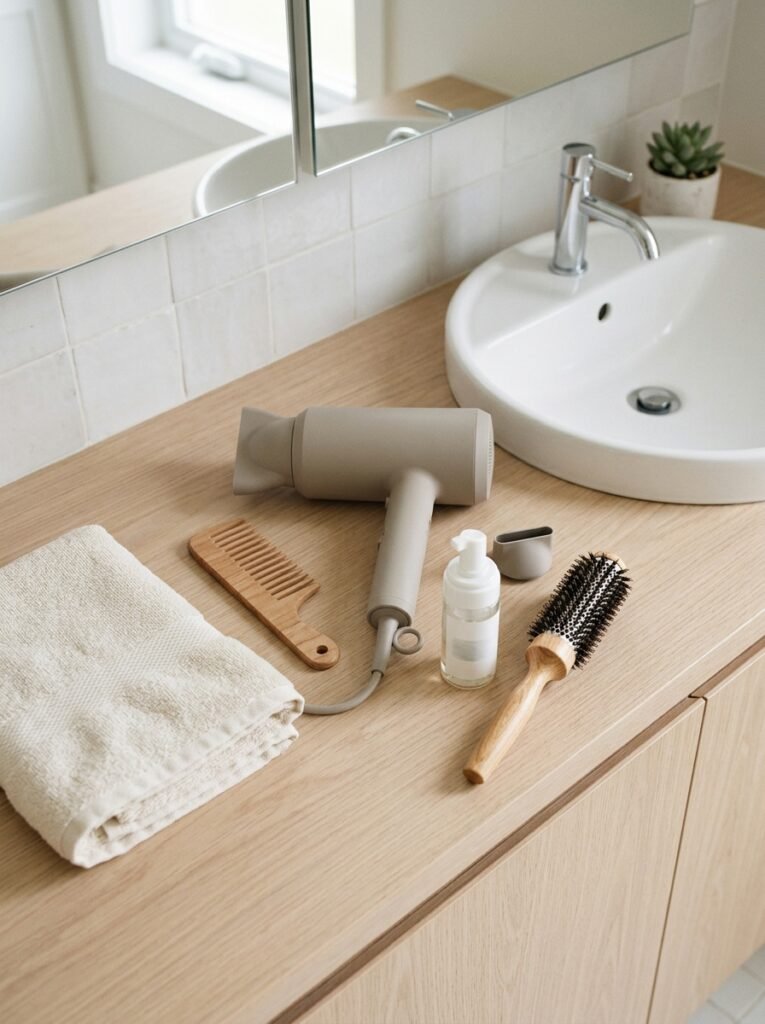
Dry your roots upside down. Flip your head over, rough dry until it’s about 80 percent dry, then flip back and finish. Costs nothing, adds real volume at the crown.
Blow dry in the opposite direction to how you want it to sit. Aim the airflow against the natural fall of the hair at the roots. When you let it settle back it’ll sit up rather than lying flat.
Switch to a lightweight mousse or a root spray. Heavy creams, oils and thick conditioners applied near the scalp will flatten fine hair immediately. Keep conditioner to the mid lengths and ends only.
Try a slightly lighter colour at the roots or fine highlights around the parting. This one surprises people. Lighter hair near the scalp reduces the contrast between hair and skin, so the gap becomes far less visible. Dark hair on a pale scalp is the highest contrast combination there is.
Dry shampoo as a texture product, not just for grease. A little at the roots on clean hair gives grip and lift.
If you want to go deeper on the styling side specifically, there’s a whole piece on styling tricks that build volume in finer hair that covers the product and technique side in more detail than I can fit here.
Habits That Make It Look Worse
Some of these I did for years without realising.
Tight ponytails and buns worn constantly. Persistent tension on the hairline causes real damage over time, and it’s most likely to affect the temples, which is exactly where you’re already thinning. Loosen them, vary the position, and don’t sleep in them.
Brushing hard when wet. Wet hair stretches and snaps. Use a wide tooth comb, start at the ends, work up.
Very hot tools used daily without protection. Finer hair has less to lose before damage shows.
Growing it long specifically to hide the thinning. It’s the instinct almost everyone has and it backfires nearly every time, for all the weight reasons above.
Over-washing, or under-washing. Both cause problems. Product and oil buildup at the scalp flattens roots and can irritate the skin. Too frequent washing with harsh shampoo does its own damage. Most people land somewhere around every two or three days.
Waiting nine months between trims. Split ends travel up the strand and make the ends thinner still. Every eight to twelve weeks keeps that blunt edge intact.

How to Actually Say It to Your Stylist
This part is awkward for a lot of people and it really doesn’t need to be.
Stylists see thinning hair constantly. It is a completely ordinary part of their week and they are not going to be surprised or make it weird. What they can’t do is read your mind, and a stylist who doesn’t know your priority is density will happily put in the layers that make it worse.
Some useful things to say:
- “My hair has got a lot finer over the past couple of years and my priority is making it look denser.”
- “I’d rather keep the weight in it, so please go easy on the layering.”
- “My parting has widened and I’d like a cut that doesn’t put the focus there.”
- “Can we look at where the ends are tapering? I want them blunter.”
You can also just say “the top has thinned out and I’m not thrilled about it, what would you do?” Being direct gets you better results than hinting, and most stylists are relieved when a client raises it first.

Things People Ask
Will cutting my hair make it grow back thicker?
No, and any product promising that is overreaching. What cutting does is remove the tapered, damaged ends so the hair you have looks and behaves thicker. That’s a genuine improvement, just not a change in growth.
Is it too late to do anything if I’m already in my fifties?
Not at all. Cut and styling adjustments work at any age, and if there’s an underlying cause it’s still worth investigating whenever you notice it.
Should I stop colouring my hair?
Not necessarily. Modern colour is far gentler than it used to be, and lighter tones near the scalp genuinely help disguise thinning. Frequent bleaching is harder on fine hair, so it’s worth discussing with your colourist, but colour on its own isn’t the villain here.
Do volumising shampoos actually work?
Somewhat. They mostly work by not weighing hair down rather than by adding anything, which is still useful. Don’t expect dramatic results, and be careful with anything very heavy in silicones if flatness is your issue.
My hair sheds loads in the shower. Is that the same thing?
Not necessarily. Losing somewhere around 50 to 100 hairs a day is normal, and it looks like a lot when it collects. The thing to watch is whether your overall density is dropping, not how much comes out on any given day. A sudden and sustained increase in shedding is worth mentioning to a doctor.
Will extensions help?
They can look good but they add tension at the root, which is the last thing thinning hair needs. If you go that route, talk to someone experienced with fine hair specifically and don’t leave them in too long.

Where This Leaves You
The bit I wish someone had told me earlier is that this is a solvable styling problem far more often than it’s a crisis. It just doesn’t feel that way when you first notice it.
Get the blood test if anything about it seems off. Then book an appointment, be honest about what’s happening, and let the cut do what it’s good at. Shift your parting, dry your roots properly, stop tying it back so tightly.
None of it is dramatic. Together it adds up to hair that looks a good deal fuller than it did, which was the point all along.