How to Find Your Face Shape at Home in Under Five Minutes
There is a moment in every salon appointment where the stylist swivels the chair, looks at you in the mirror, and says something like “well, with your face shape, I’d probably go a little longer at the front.” And you nod. You nod like you have any idea what she just said about your face.
I nodded for about fifteen years before I finally sat down with a tape measure and figured it out. It took four minutes. Four minutes, after fifteen years of pretending.
The strange part is how much easier everything got afterward. Not because knowing your face shape unlocks some secret perfect haircut, it really doesn’t work like that. But because I stopped saving photos of styles that were never going to sit right on me, and started recognising why certain cuts always looked better in the mirror than others.
So let’s get you sorted. Grab a few things and we’ll do this properly.
The Sixty Second Version, If You’re in a Hurry
Not everyone wants the full breakdown. If you’re standing in a bathroom right now trying to decide something before an appointment, here it is:
- Pull your hair completely back off your face
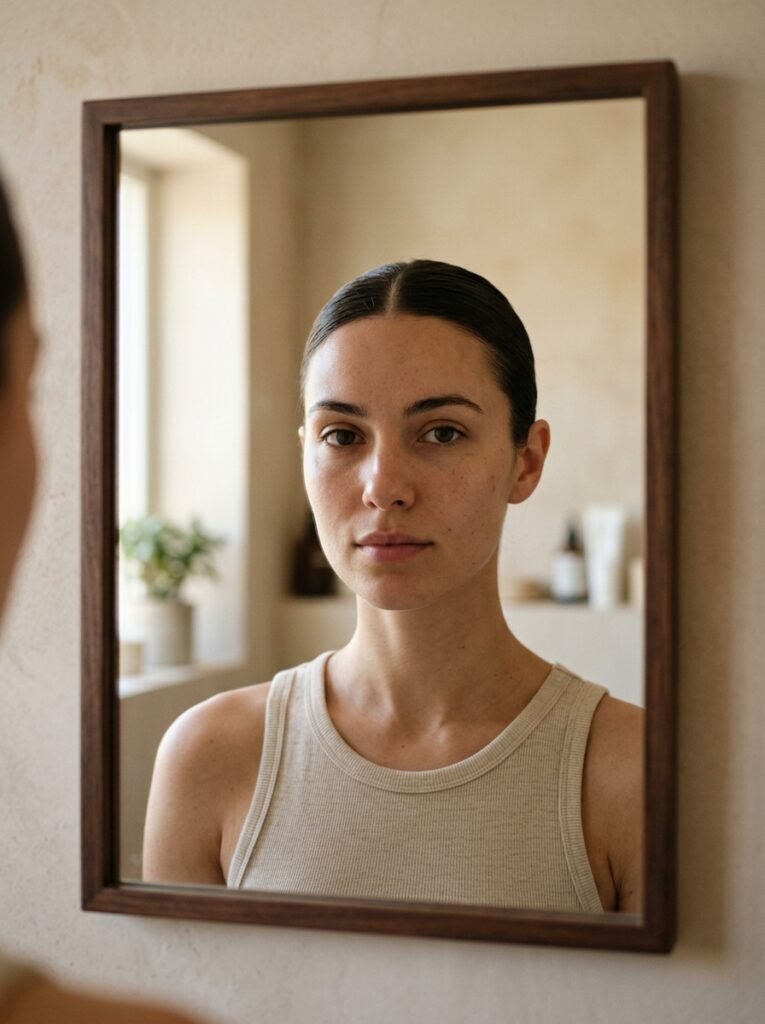
- Look straight into a mirror
- Ask yourself: is my face longer than it is wide, or roughly the same?
- Then ask: what is the widest part, my forehead, my cheekbones, or my jaw?
- Then: is my jawline soft and curved, or does it have a visible corner?
Those three answers get most people to the right shape without measuring anything. Longer than wide with a soft jaw and cheekbones as the widest point puts you in oval territory. Same length as width with soft edges is round. Same length as width with a defined corner at the jaw is square.
That’s the fast lane. It’s right maybe eight times out of ten, and the measuring method below is for the two times it isn’t.
What You Actually Need
Almost nothing, which is the good news.
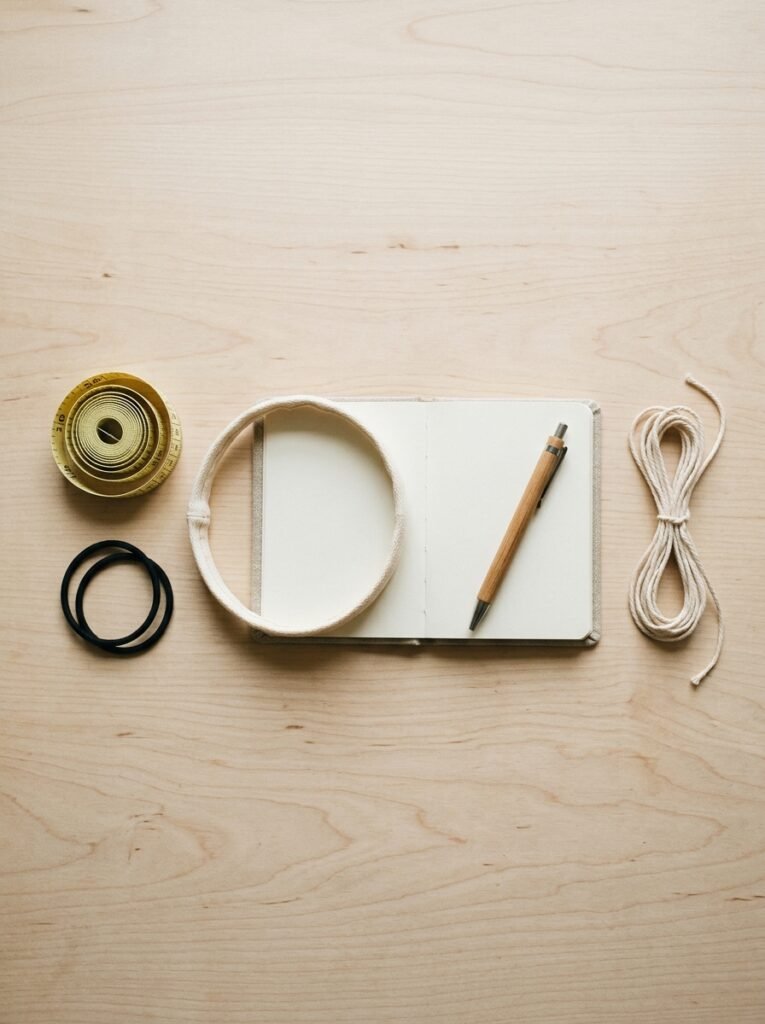
- A soft measuring tape, the fabric kind used for sewing
- A mirror you can stand in front of comfortably
- A hair tie or headband
- Somewhere to jot four numbers down, your phone notes app is fine
No soft tape? A piece of string works completely fine. Measure the string against a ruler afterward. I did it this way the first time because my measuring tape had vanished into the same void that eats single socks.
One thing that genuinely matters: pull your hair fully back. Every strand. A fringe or a few loose pieces around your temples will throw your forehead measurement off by a centimetre or more, and a centimetre is enough to push you from one shape into another. Headband, tight ponytail, whatever works.
The Four Measurements That Actually Matter
Take these in order. Write each one down as you go, because trying to remember four numbers while holding a tape measure against your own face is more difficult than it sounds.
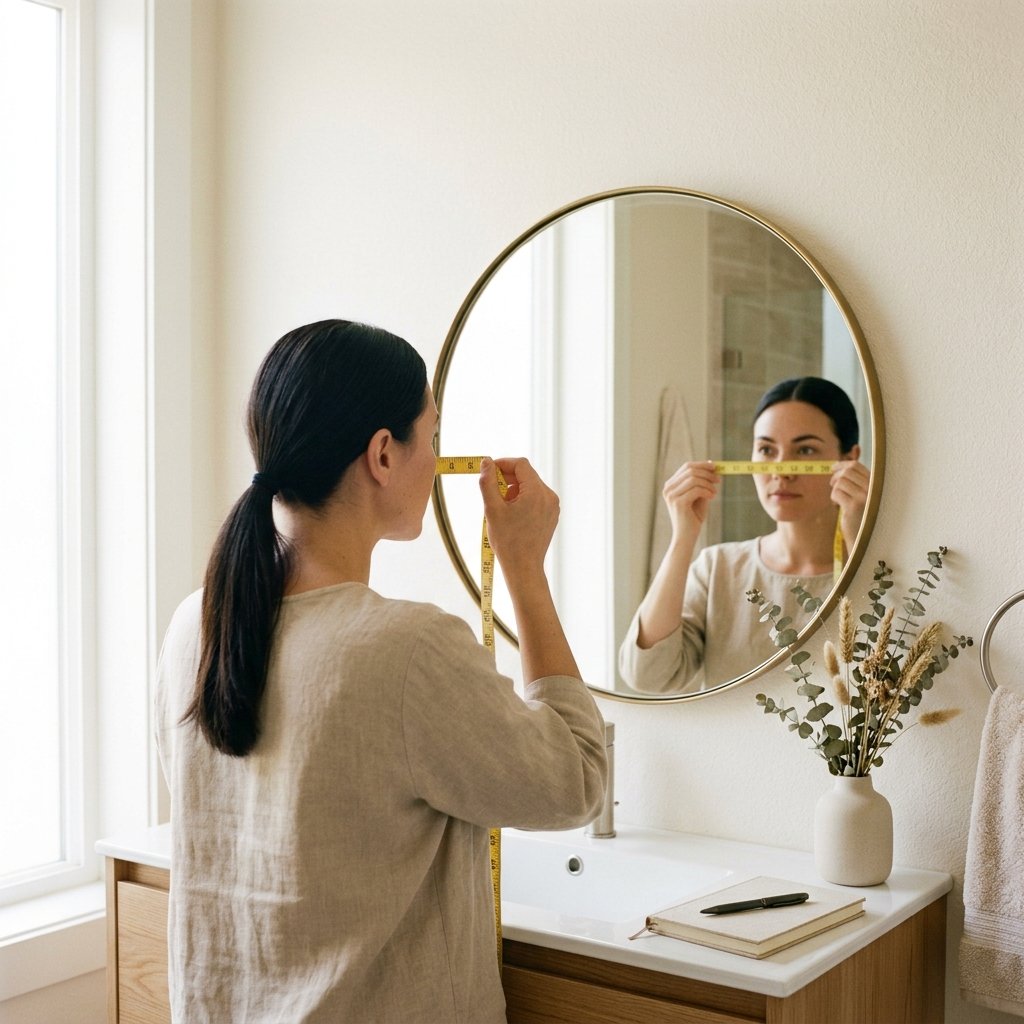
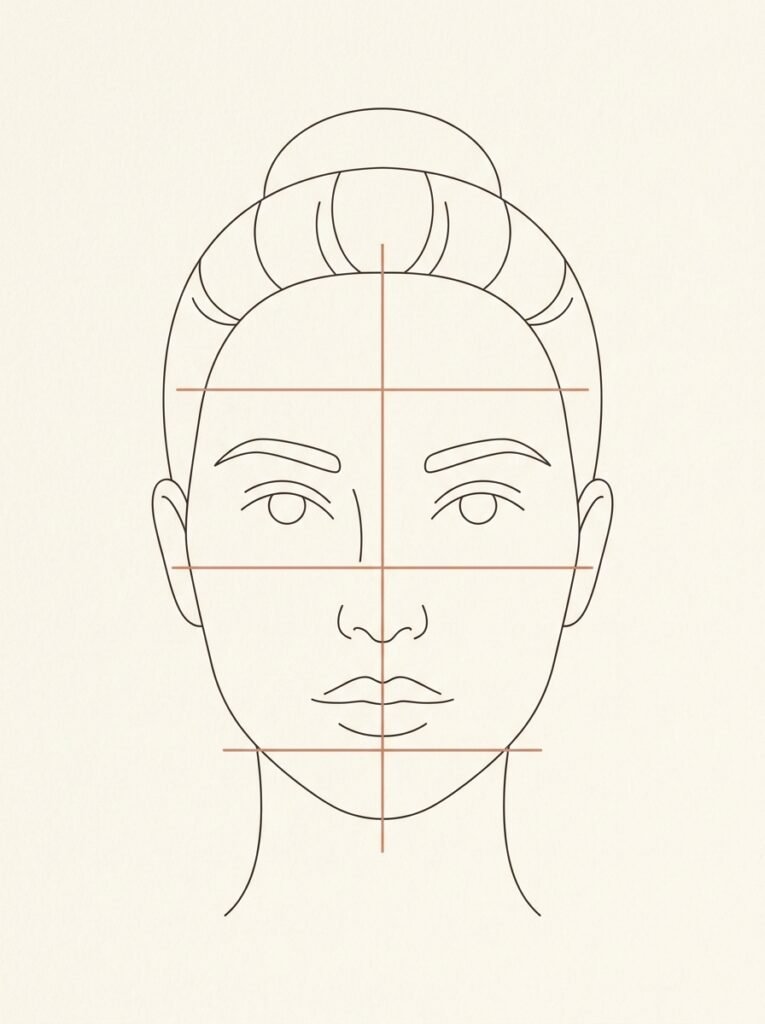
Forehead width. Find the widest point across your forehead, which is usually about halfway between your eyebrows and your hairline. Measure straight across from one side to the other.
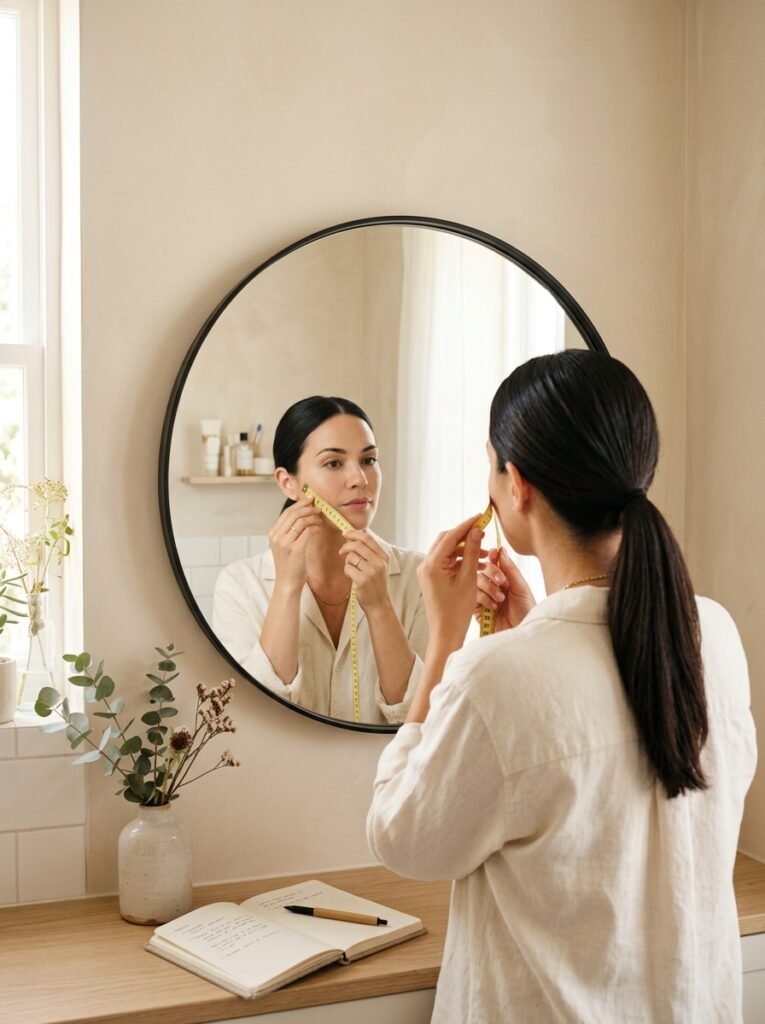
Cheekbone width. Start at the pointed bit just below the outer corner of one eye. That little ridge you can feel if you press gently. Measure straight across your face to the same spot on the other side.
Jawline. This one trips people up. Measure from just below your ear to the very tip of your chin, following the line of your jaw. Then double that number. You’re measuring one side and doubling it, not going all the way around.
Face length. From the centre of your hairline straight down to the bottom of your chin. Keep the tape vertical and don’t let it curve over the shape of your face.
Four numbers. Now the interesting part.
Reading Your Numbers
Look at your four measurements and find the largest one. Then look at how close the other three are to each other. Those two observations do almost all the work.
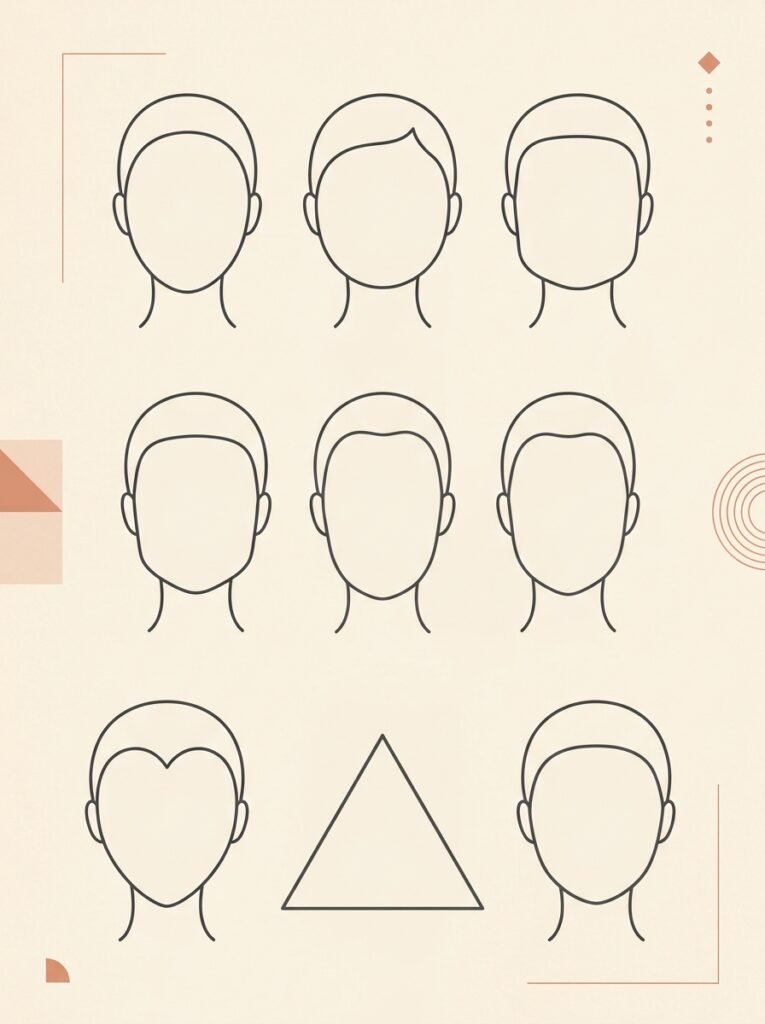
Oval. Your face length is your biggest number, and it’s noticeably larger than your cheekbone width. Your forehead is slightly wider than your jaw, and your jawline curves rather than corners. This shape gets called the most versatile, and there’s some truth in that, though I’d gently push back on the idea that oval faces can wear literally anything. Everyone has something that doesn’t suit them.
Round. Your cheekbone width and your face length come out close to equal, sometimes within a centimetre of each other. Your forehead and jaw are similar widths too, and there’s no sharp angle where your jaw meets your ear. Soft all the way around.
Square. All four numbers land in a similar range, but here’s the difference from round: your jaw has a visible corner. Run your fingers along it. If you feel a distinct angle rather than a curve, you’re square rather than round, even if the numbers look almost identical.
Rectangle, sometimes called oblong. Your face length is clearly the biggest number, and your forehead, cheekbones and jaw are all fairly close to each other. Think of it as a longer version of square. The jaw may be angled or slightly softer.
Heart. Your forehead is your widest measurement. From there your face narrows down through the cheekbones to a jaw that’s noticeably smaller, finishing in a chin that comes to more of a point than a curve.
Diamond. Cheekbones are widest, and your forehead and jaw are both narrower than them. Face length is usually your largest number overall. The chin tends to be pointed rather than square.
Triangle, sometimes called pear. Your jaw is the widest measurement, wider than both your cheekbones and your forehead. Less commonly talked about, but real, and worth knowing if it’s yours.
When Your Numbers Refuse to Cooperate
Here’s the part most guides skip over, and it caused me a fair bit of confusion the first time round.
Plenty of people don’t land cleanly in one category. You might have a round face length ratio with a square jaw. You might measure as heart shaped but have cheekbones that are almost as wide as your forehead, putting you somewhere between heart and diamond.
This is completely normal. Real faces don’t sort themselves into seven tidy boxes.
When you’re stuck between two shapes, use the jawline as your tiebreaker. It’s the feature that changes how a haircut sits more than any other single thing, more than forehead width and usually more than face length. A soft curved jaw and a defined angular jaw want different things from a cut, even on faces that measure identically everywhere else.
If you’re between round and square, go with what your jaw is doing. Between oval and rectangle, same answer.
And if you genuinely can’t decide, treat yourself as the shape you’re closest to and stay flexible. Nobody is going to check your work.
The Photo Trick That Confirms It
Once you’ve got a shape in mind, this takes thirty seconds and settles most lingering doubt.
Take a photo of yourself facing straight forward, hair pulled back, neutral expression, in natural daylight if you can manage it. Don’t smile, because smiling changes your cheek width noticeably.
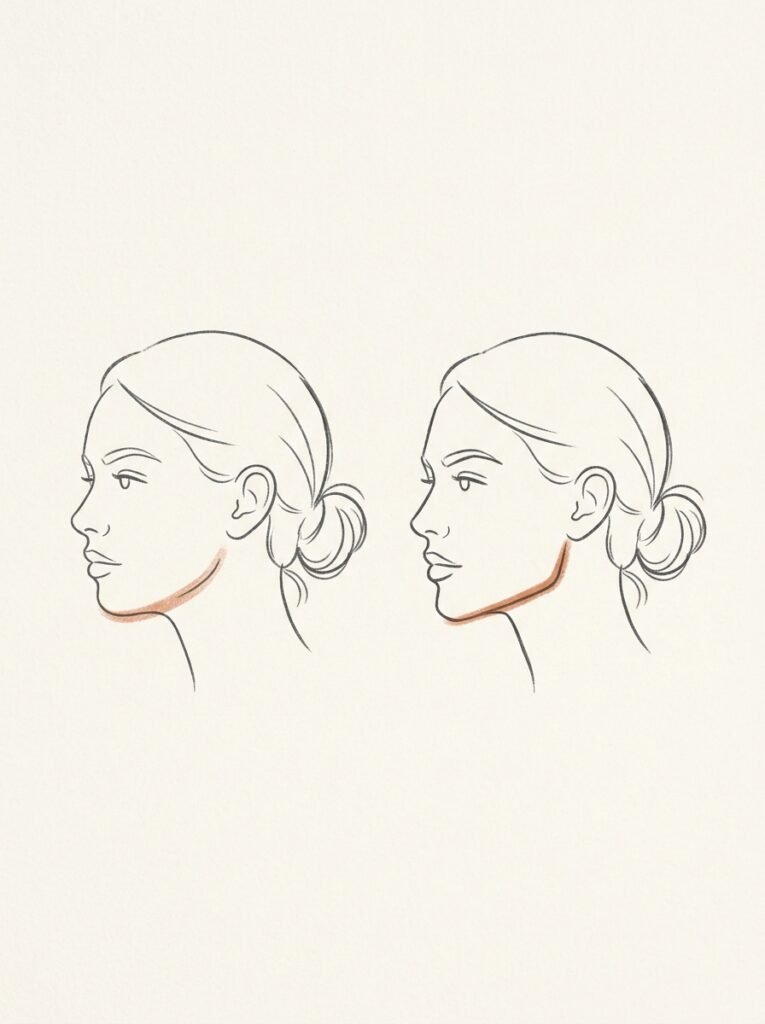
Now open the photo and use whatever markup tool your phone has. Draw a line around the outer edge of your face, following your hairline across the top and your jaw around the bottom. Ignore your ears entirely.
Then look at just the outline. Not your features, not your hair, just the shape you drew.
It’s much easier to see an oval or a square when you’re looking at a plain outline instead of an actual face. Something about seeing your own features gets in the way of judging the shape underneath them. My sister swore she had a round face for years. She drew the outline, sat there for a second, and said “oh. That’s a square, isn’t it.” It was.

Mistakes That Throw the Whole Thing Off
I got this wrong twice before I got it right, so learn from my wasted afternoons.
Measuring with your hair down. Already mentioned it, mentioning it again because it’s the single most common error. Even a soft side-swept fringe adds phantom width to your forehead.
Measuring your hairline instead of your forehead. These are different. Your forehead is widest partway up, not right at the hairline. If you have a receded or uneven hairline this matters even more.
Going all the way around the jaw. Half the jaw, then double it. Wrapping the tape around the full curve gives you a number far too large and can push you toward square or triangle incorrectly.
Tilting your head. Even a small tilt shortens your face length measurement. Chin level, eyes forward.
Doing it at the end of a long day. Slight facial puffiness is real, particularly around the jaw and under the eyes. Morning measurements tend to be more consistent.
Trusting an app over your own tape. The face shape filters and apps are entertaining but they’re inconsistent, and I’ve had the same photo return three different answers from three different apps. Four measurements and two minutes will beat them.
So You Know Your Shape. Now What?
This is where the useful part starts, and also where I’d offer a bit of caution.
Face shape is one input. It is not a rulebook. The advice that certain shapes must never have certain cuts is mostly recycled from magazine columns written decades ago, and plenty of it doesn’t hold up. Hair texture, density, height, glasses, personal style and how much time you’re honestly willing to spend styling in the morning all matter as much or more.
What your shape genuinely helps with is understanding proportion. If your face reads long, cuts that add width at the sides tend to balance it. If your face reads wide, length and vertical lines tend to do the same job in reverse. That’s the whole principle, and it’s simpler than the internet makes it sound.
Once you know your shape, the natural next step is working out which cuts play to it, and there’s a full walkthrough on choosing a haircut that suits your proportions that goes into that side of it properly.
Take your shape to your next appointment as information, not as an instruction. “I’ve got a square jaw and I’m not sure whether a blunt bob would emphasise it too much” is a far more useful thing to say to a stylist than “what do you think?” It gives them something to work with, and most stylists are genuinely pleased when a client turns up with a bit of self knowledge.

Questions People Ask About This
Can my face shape change over time?
The underlying bone structure doesn’t really change once you’re through your growth years. What can shift is how it reads. Weight changes affect fullness through the cheeks and under the chin, and the natural loss of collagen over the years can make a jaw look softer or more defined than it once did. Worth remeasuring every few years rather than treating one result as permanent.
Does hair length change my face shape?
No, but it changes how your shape appears, which is arguably more relevant day to day. A cut ending at the chin draws attention to the jaw. Volume at the crown makes a face read longer. Nothing about your bones has moved, but what people notice has.
Why do I get different answers from different sources?
Because different guides use different numbers of categories. Some work with three shapes, some with six, some with nine. A face that’s a rectangle in one system is an oblong in another and a long oval in a third. The measurements aren’t disagreeing, the labels are. Pick one system, stick with it, and don’t worry about the rest.
Do I need to know my face shape at all?
Honestly, no. Plenty of people have great hair without ever thinking about it. It’s a useful shortcut for narrowing down options when you’re facing a big change or feeling stuck, and it’s a helpful vocabulary for talking to a stylist. But it’s a tool, not a requirement, and anyone telling you your face shape determines what you’re allowed to wear is overstating it considerably.
What if my face isn’t symmetrical?
Almost nobody’s is. Measure the wider side, or measure both and use the average. A small difference between sides is so common it’s basically the default, and it won’t change your category.
My forehead and cheekbones measure exactly the same. What now?
Look at your face length and your jaw. If the length is close to the width, you’re in round or square territory depending on the jaw angle. If the length is clearly greater, you’re looking at oval or rectangle, again decided by the jaw. The tiebreaker is nearly always the jaw.
One Last Thought Before You Grab the Tape
The whole thing genuinely takes less time than choosing what to watch in the evening. Four measurements, a quick look at which number is biggest, and a photo outline if you want to double check.
What surprised me most wasn’t finding out my shape. It was realising how many years I’d spent quietly assuming certain styles just “didn’t work on me” without ever understanding why, and how much less frustrating hair decisions became once I had a reason instead of a vague feeling.
You might measure and discover you were right all along. That’s a perfectly good outcome too. At least now you’ll know, and the next time a stylist swivels the chair and mentions your face shape, you’ll be able to say something back.